
How Owensboro Arrests Become Records
Owensboro sits at the center of Daviess County as its seat and biggest city. The 2020 Census put 60,183 people there. Census QuickFacts estimates 60,892 for 2025. Policing splits among several agencies. The Owensboro Police Department works out of 222 East 9th Street. The Daviess County Sheriff's Office covers the whole county. Kentucky State Police or other agencies can also make arrests inside city limits. Each one writes its own report of the event.
A report, though, is only part of the paper trail. When an arrest ends in county booking, the Daviess County Detention Center builds and keeps the jail record. So OPD can hand you a complaint, offense, or CAD report tied to its case. DCDC is the source for the booking entry and any releasable photograph. A roster entry also just shows custody at one moment. Check the Daviess court file for what happened after.
Where Owensboro Busted Mugshots Appear
Go official first. DCDC posts a link to its current JailTracker roster, and OPD publishes instructions for requesting records rather than a standing mugshot list. News archives and commercial sites can offer leads. None of them replaces the custodian's own record.
| Channel | What it shows | Status | Access |
|---|---|---|---|
| DCDC JailTracker | Current custody fields; a photo may appear, but is not guaranteed | Official | Online roster or jail contact |
| OPD records | Police incident, offense, CAD, or collision reports | Official | Records request |
| Kentucky CourtNet and clerk | Case progress and disposition after booking | Official | Online or clerk request |
| Owensboro Times | Dated arrest posts and selected case stories | Independent media | Publisher archive |
| County aggregator pages | Copied booking cards or older images | Unofficial | Verify every item |
DCDC's public-information page supports name, age, arrest date, bond information, charges, and release dates for past inmates. It does not promise a photograph for every entry. When JailTracker shows an image, that picture is the one the current official interface displays for the record. No photo? Ask DCDC directly whether it maintains a releasable one. Don't settle for a copied image floating around online as if it were official proof.
Busted in Owensboro: Lookup Steps
The quickest search traces the record from the arresting agency to whoever holds it now. Bring dates and case numbers. They cut down on mistaken identity. That matters a lot when common names repeat.
- Search the official DCDC roster by the person's correct name. Note the arrest date, charges, bond, and the time you checked the entry.
- Identify the arresting agency. For an OPD event, use the police records route; for a sheriff event, contact DCSO. The report and booking sheet are separate records.
- If no photo appears, submit a focused DCDC request that names the person and booking date and asks whether a booking photograph is maintained and releasable.
- Check CourtNet or the Daviess Circuit Court Clerk for the case disposition. A booked charge can change after arraignment, the first court appearance, or later proceedings.
- If the person has moved to state custody, use Kentucky Online Offender Lookup, known as KOOL. Federal custody requires the appropriate federal locator.
Someone released from custody can vanish from the live roster while the booking record still sits in agency files. Also, no official page promises a same-day, 48-hour, 72-hour, or weekly Owensboro booking feed. A blank screen or endless loading means nothing by itself. Reload the DCDC wrapper first. Then try its embedded JailTracker interface. If access still fails, call DCDC at 270-685-8466.
Owensboro Police Busted Record Requests
OPD's records page wants specific identifiers: a case number if you have one, the complainant's name and address, the offense type, the date, and the location. Fees are straightforward. A CAD or criminal report runs $1.50, a walk-in collision report for an involved party costs $5, and an authorized-business collision report is $10. Private or sensitive material can be withheld. Court files go through the separate Kentucky judiciary route.
City open-records requests must be written, delivered in person, by mail, or by email, and police requests go to OPD. The policy allows five business days for a response, charges ten cents per page plus postage, and asks for a specific description and Kentucky residency information. Those terms cover city-held police reports only. A jail booking photo belongs with DCDC, whose own process lists the same five-business-day written-response window and ten cents per copy plus postage.
Owensboro Police Department
222 East 9th Street
Owensboro, KY 42303
Main:
270-687-8888
Records: 270-687-8845
The official OPD records page shows the request choices and current contact details.
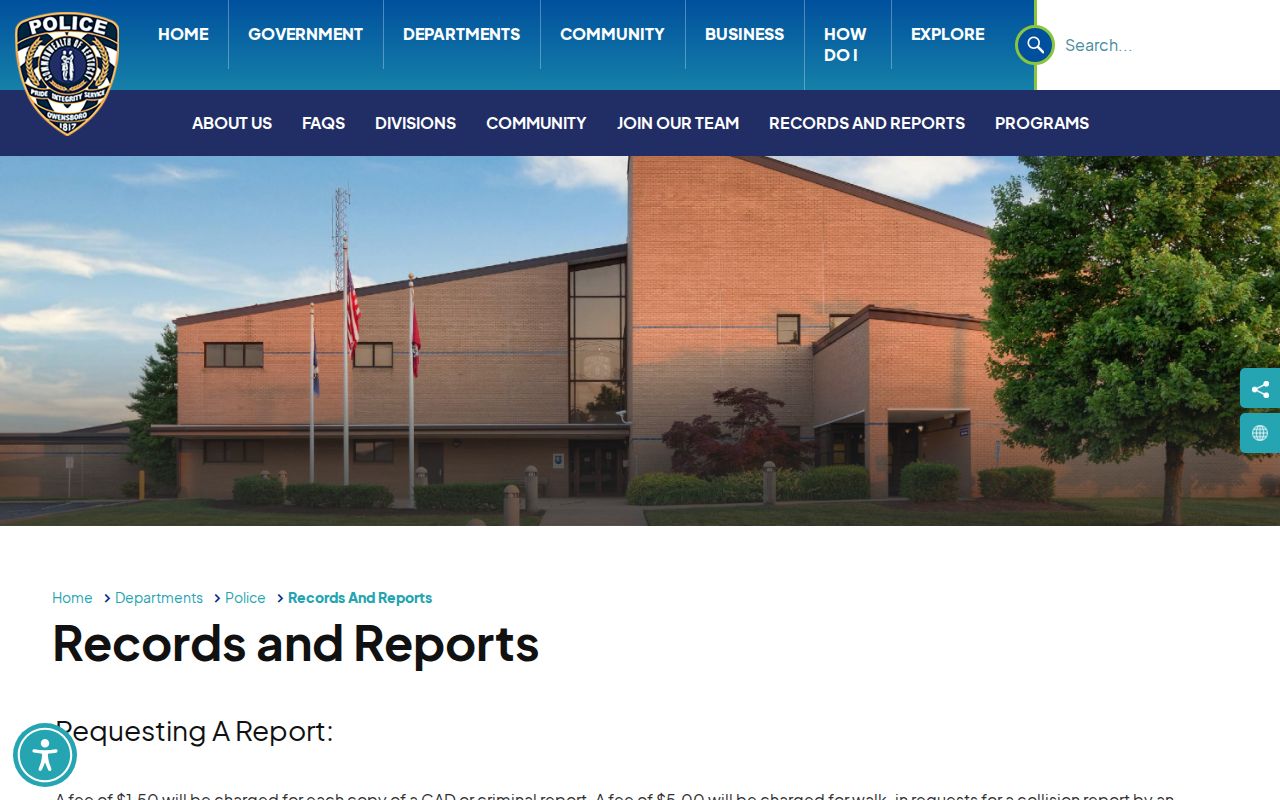
In short, Owensboro police reports and county jail booking records travel down two separate request paths.
No Official Owensboro Busted Feed
No verified "booked today" feed with a stated refresh interval exists at either OPD or DCDC. The live roster comes closest to an official custody view. Nobody promises how fast it updates. Owensboro Times fills part of that gap with dated arrest posts, often published daily when records come in. Treat them as a media window, not a jail window. They can skip DCSO, KSP, federal, or other bookings, and they may lag behind the event itself.
The Owensboro Times arrest category works best as a clearly labeled secondary lead.

That dated layout can help you narrow a search window. A missing post, though, proves little. It does not confirm or rule out DCDC custody on its own. Check the name and date with the jail or the arresting agency first. Only then should you draw any conclusions.
Owensboro Booking Versus Custody
One person's name can generate several records because each system captures a different stage. "Booking" is the jail intake process. "Bond" is the court-set condition for release. "Disposition" is the court's final result. A transfer can move someone off the county roster entirely while the original booking event stays on file.
- OPD report
- Describes the police event and the charges recorded by city officers.
- DCDC booking
- Records county jail intake and custody fields, with a photo only where displayed or released.
- KOOL record
- Tracks a person in Kentucky correctional custody or supervision after the county stage.
- Court disposition
- Shows how the filed case ended and is the proper check on a booked charge.
Owensboro Busted News Sources
Owensboro Times has the strongest city-facing records category in the research. Messenger-Inquirer publishes recurring police-report items and local stories. 14 News and Owensboro Radio cover selected cases based on OPD, DCSO, KSP, or other agency releases. Their publication schedules are editorial and event-driven. A story may use an agency-supplied or DCDC image, yet it remains a report about a selected case, not a complete booking archive.
Commercial county pages operated by Busted Newspaper, RecentlyBooked, Mugshots.com, Arrests.org, and Mugshots.zone can also contain Owensboro labels. They follow publisher-controlled update and archive rules. Some may preserve a copied photo after release or after the legal case changes. Treat them only as unofficial leads, verify identity and disposition against the original agency and court, and do not use an old publisher page to claim present custody.
No gallery is reproduced here. That protects context and keeps the search focused on authoritative records. For a broad county treatment, the Daviess County official booking and roster resources explain the full custody chain. Use media only after those channels and always date what you find.
News dates also need careful reading. The date on an Owensboro Times item is a publication date, which may differ from the incident date or DCDC intake date. Aggregator labels can reflect data copied before a release, transfer, amendment, or court ruling. Preserve each date with its source instead of merging them into one timeline. If two sources conflict, the arresting agency can address its report, DCDC can address the booking record, and the clerk can certify the case outcome.
Identity deserves the same care. Match more than a name before concluding that two entries concern the same person. A booking date, agency, case number, age, and charge description can help distinguish records, but only fields released by the official custodian should be treated as authoritative. A publisher's image or city label is not enough by itself. This method keeps an Owensboro search tied to the actual record and reduces the risk of repeating an old or wrongly matched accusation.
Social posts from an agency can alert the public to a selected investigation, but DCSO and OPD social channels are not complete booking feeds. A post can be edited or removed, and it may name charges before the prosecutor or court acts. Save the case or report number when one is supplied, then return to the agency record and court file. The same limit applies to annual police and sheriff statistics. Offense totals describe reported law enforcement activity, not a count of booking photographs or a list of people admitted to DCDC.
For release questions, rely on current custody information from DCDC rather than a news archive. The jail says release dates for past inmates may be public, while current-inmate release dates are among the information it does not release. Bond shown on a record is also not a fixed release time. Court action, another detainer, or a transfer may affect custody. Calling the jail is the sound fallback when the online interface cannot settle a time-sensitive status question.
Public Record Search
Sponsored Results